Read online The Law of Dependent Arising: The Secret of Bondage and Release (The Law of Dependent Arising, #1) - Bhikkhu Katukurunde Nyanananda file in ePub
Related searches:
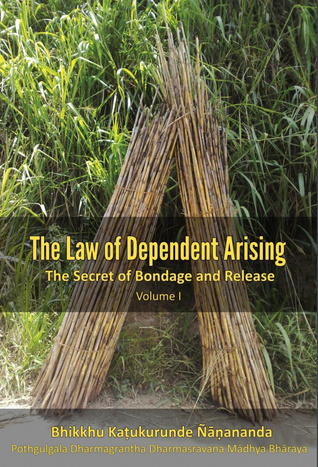
The Law of Dependent Arising: The Secret of Bondage and Release
The Law of Dependent Arising: The Secret of Bondage and Release (The Law of Dependent Arising, #1)
Transcendental Dependent Arising: A Translation and
Thai buddhist philosophy and the action research process
Dependent Law and Legal Definition USLegal, Inc.
The Dependent Origination The law of cause and effect
Publication 929 (2020), Tax Rules for Children and Dependents
Dependent Health Coverage and Age for Healthcare Benefits
Teaching the Fundamental Exposition and Detailed Analysis of
Harmony of Emptiness and Dependent-Arising by Lobsang Gyatso
Cases Arising Under the Constitution, Laws, and Treaties of
The substance of the teaching is as follows: dependent on ignorance (avijjā) mental formations (sankhārā) arise.
22 mar 2020 this book describes in detail the buddha's marvelous realization about the law of dependent origination (paṭiccasamuppāda).
The principle governing pratityasamutpada or dependent arising - also called interdependent origination and conditioned co-production - is a cornerstone in buddhist philosophical thought.
One is the law of dependent arising (paṭicca samuppāda) or conditionality (idappaccayatā). The other is nibbāna – the stilling of all preparations (sabba-saṅkhāra-samatha).
This arising, that arises (imassa uppādā idam uppajjati) when this is not, that is not (asmin asati idam na hoti) this ceasing, that ceases (imassa nirodha idam nirujjhati) understanding of buddhism depends on how far we have understood this theory, the dependent origination. If someone has a clear knowledge, he is knowledgeable about suffering.
Co-arising works as an explanation both for the arising of dukkha—stress or suffering—and for the fact that dukkha can be ended through a path of practice. The two most prominent analogies offered by the post-canonical buddhist tradition—depicting dependent co-arising as a wheel or as a circle of mirrors—are inadequate to this task.
The law of dependent arising: the secret of bondage and release. One of the most scholarly monks of sri lanka gives us this interesting and deep look into the most important ideas that the buddha taught which is dependent origination or paticca samuppada.
The fully enlightened buddha made known to the world that saṁsāric existence is a cyclic process in that it is a going the same round again and again. That indeed is the true meaning of the term ‘saṁsāra vaṭṭa’. The two significant words ‘saṁsarana’ and ‘nissaraṇa’ are also suggestive of a going round and an continue reading.
''the law of patthana'' of the abhidhamma pitaka is known as the ''law of relations'' or cause-effect and paticca samuppada can be more accurately translated as ''law of dependent origination''. There are 24 types of relations, as explained in ''the law of '' patthana '', on which cause-effect are based.
Keywords: dependent origination, natural law, systems theory, emotions, conscious- ness, ethics, society, entrepreneurial opportunity.
The 'dependent origination' doctrine, states peter harvey, highlights the buddhist notion that all apparently substantial entities within the world are in fact wrongly.
7 jul 2013 “what, monks is dependent arising? conditioned by birth, monks, is decay-and- death.
Dependent origination dependent origination, or often called dependent arising, is considered by some buddhist scholars to be the foundation of all other buddhist study and practice.
In obligtations arising from the law, quasi-contracts, criminal offenses, and quasi-delicts, the obligation to deliver arises from the time designated by the provisions of the civil code or of special laws creating or regulating them.
15 nov 2017 in this paper, the doctrine of dependent origination is examined as a resource for conceiving of a relationship between human beings and nature.
A dependent is a person other than the taxpayer or spouse who entitles the taxpayer to claim a dependency exemption. Each dependency exemption decreases income subject to tax by the exemption amount.
Central to buddhist philosophy and practice is the principle of dependent origination, sometimes called dependent arising. In essence, this principle says that all things happen through cause and effect and that they are interdependent.
One of tibet's great scholars presents the buddha's profound teachings on the laws of karma and dependent arising.
Understanding the law of dependent origination, how because of one thing something else arises, we can begin to break the chain of conditioning.
Including lagged dependent variables can reduce the occurrence of autocorrelation arising from model misspecification. Thus accounting for lagged dependent variables helps you to defend the existence of autocorrelation in the model.
Pratītyasamutpāda (sanskrit: प्रतीत्यसमुत्पाद pratītyasamutpāda; pali: पटिच्चसमुप्पाद paṭiccasamuppāda), commonly translated as dependent origination, or dependent arising, is a key doctrine of buddhist philosophy, which states that all dharmas (phenomena) arise in dependence upon other dharmas: if this exists, that exists; if this ceases to exist, that also ceases to exist.
This structural principle that underlies all phenomena is the law of conditionality. That is, whatever arises, arises in dependence on conditions; everything that.
The doctrine of paticca samuppada or dependent co-arising is fundamental to buddhist ethics.
Conditionality — the fundamental law� the teaching of dependent arising has two aspects: an abstract principle or what we might call a structural principle; the application of that principle to the problem of suffering.
Dependent arising (paticcasamuppada) is the central principle of the buddha's teaching, constituting both the objective content of its liberating insight and the germinative source for its vast network of doctrines and disciplines. As the frame behind the four noble truths, the key to the perspective of the middle way, and the conduit to the realization of selflessness, it is the unifying theme running through the teaching's multifarious expressions, binding them together as diversified.
10 jul 2016 short talk by the dalai lama on the 'law of causality and dependent origination'.
The law of dependent arising - paṭicca samuppāda is at the heart of buddhism.
Cases arising under the constitution, laws, and treaties of the united states cases arising under the constitution are cases that require an interpretation of the constitution for their correct decision. 800 they arise when a litigant claims an actual or threatened invasion of his constitutional rights by the enforcement of some act of public authority, usually an act of congress or of a state.
[the twelve links of] dependent origination is a profound teaching on how consciousness operates. It presents a series of twelve linked factors that shape and drive the heart, and thereby push us “unconsciously” into suffering. With the aid of this analysis, we can become conscious of this process and break the links in the sequence.
The principle of sufficient reason states that everything must have a reason or a cause. The modern formulation of the principle is usually attributed to early enlightenment philosopher gottfried leibniz, although the idea was conceived of and utilized by various philosophers who preceded him, including anaximander, parmenides, archimedes, plato and aristotle, cicero, avicenna, thomas aquinas.
One is the law of dependent arising (paṭicca samuppāda) or conditionality (idappaccayatā). The other is nibbāna – the stilling of all preparations (sabba-saṅkhāra-samatha). Owing to the very profundity of the law of dependent arising, hardly a century after the passing away of the buddha, a number of buddhist sects that sprang up offered a wide variety of interpretations of this central philosophy.
97–248, § 202(a), substituted provisions that there shall be allowed as a deduction the expenses paid during the taxable year, not compensated for by insurance or otherwise, for medical care of the taxpayer, his spouse, or a dependent (as defined in section 152), to the extent that such expenses exceed 5 percent of adjusted gross income, for provision allowing as deductions the amount by which the amount of the expenses paid during the taxable year (reduced by any amount deductible.
Dependent origination (interdependent origination) the process of causation, in which all phenomena are created, sustained, and pass in dependence on causes and conditions. It is composed of the 12 links (nidānas) 12 links (nidānas) of dpdt orig (intdp orig).
The doctrine of dependent arising presents the buddhist perspective on the nature of causality, whose understanding is considered equivalent to an understanding of the teaching of the buddha, the dharma (trenckner and chalmers 1888–1896, i 190). The centrality of this doctrine is a recurrent theme in various passages.
He who understands the dependent origination understands the process of arising and suffering. Also, understanding the dependent origination leads to understand the supreme buddha. That's is why the buddha says; he who sees the dependent origination sees the dhamma.
The law of dependent origination is one of the important laws of the universe discovered by shakyamuni buddha (through enlightenment).
The two components of dependent origination that are included in the group of actions are mental formation and becoming. Mental formation refers to the impressions or habits that we have these impressions or habits are formed by repeated actions.
These conditions — the twelve factors — make up the practical side of the buddha’s teaching on dependent arising. These twelve factors are: ignorance; volitional formations; consciousness; mentality/materiality, six sense faculties; contact, feeling; craving; clinging; existence; birth; ageing and death.
This whole series of twelve links represents a detailed exposition of the first and second noble truths. It answers the question how did this whole mass of suffering.
The general or universal definition of pratityasamutpada (or dependent origination or dependent arising or interdependent co-arising) is that everything arises in dependence upon multiple causes and conditions; nothing exists as a singular, independent entity.
The law of causation is a prime example of the information few people know about and even fewer use when purchasing insurance. The law is comprised of doctrines that are incompatible, vary from jurisdiction to jurisdiction, and lend themselves to “logic chopping.
There shall be allowed as a deduction the expenses paid during the taxable year, not compensated for by insurance or otherwise, for medical care of the taxpayer, his spouse, or a dependent (as defined in section 152, determined without regard to subsections (b)(1), (b)(2), and (d)(1)(b) thereof), to the extent that such expenses exceed 10 percent of adjusted gross income.
One of tibets great scholars presents the buddhas profound teachings on the laws of karma and dependent arising. In the rice seedling sutra, the buddha unpacks the law of cause and effect. He notes how in the natural world, a seed becomes a sprout, which produces a flower, which bears fruit.
The doctrine of dependent origination is significant, being that any first cause, be it a creator god or whatever one may conceive it to be, is impossible.
2 nov 1999 when applied to the problem of suffering, the abstract principle becomes encapsulated in a twelve-term formula disclosing the causal nexus.
With dependent arising, the buddha is describing with great accuracy — using a different model, but observing the same thing we can observe — how it is that our ignorance of this process leads us into trouble, with the hope that if we can see what he is pointing to (in its myriad manifestations in our own lives) we can break the habits, stop performing the rituals/habitual patterns of thinking that instinct generates in us and society supports (as society seems to have its own “self.
Read 3 reviews from the world's largest community for readers.
The central concept of buddhism is generally termed interdependent co-arising or dependent co-origination.
Fact sheet #62c: who is an h-1b-dependent employer? this fact sheet provides general information concerning h-1b-dependent employers under the h-1b program. Special attestations applicable to h-1b-dependent and willful violator employers sunset on october 1, 2003, but were restored effective march 8, 2005 by the h-1b visa reform act of 2004.
Dependent origination is, of course, related to the doctrine of anatman. According to this doctrine, there is no self in the sense of a permanent, integral, autonomous being within an individual existence.
He first presents the topic of dependent arising and summarizes the doctrine: “if this exists, that arises; by this having been produced, that is produced. ” whatever is born has arisen in reliance on causes and conditions, with no cause or condition being primary or absolute.
Pratītyasamutpāda (sanskrit; pali: paṭiccasamuppāda), commonly translated as dependent origination, or dependent arising, is a key doctrine of buddhist philosophy, which states that all dharmas (phenomena) arise in dependence upon other dharmas: if this exists, that exists; if this ceases to exist, that also ceases to exist.
1 jun 2003 interdependent origination (sanskrit, pratityasamutpada) is the law of be seen as interconnected, simultaneous, and mutually dependent.
In verse #31 shantideva is not talking just about the law of karma that is also known as the law of cause and effect, although karma is an important cause for our experiences. Shantideva is talking about dependent arising whereby the outside world is an endless stream of cause and effect events.
12 oct 2016 paticca samuppāda: the law of dependent origination a forum for beginners and members of other buddhist traditions to ask questions.
Com: the law of dependent arising: the secret of bondage and release (9781517706340): nanananda, bhikkhu katukurunde: books.
By josh lazaroff� as we were about to conclude our time studying thai massage in chang mai, thailand, our teacher, pichet boonthume, told us that we had to do an 11 day silent meditation retreat before we started dong thai massage with others.
You may qualify as an “other dependent” under the new tax law changes. Here are the requirements for qualifying for the new $500 credit. The relationship between person filing and the dependent does not violate the law; for example, you cannot still be married to someone else.
Dependent: a person whose support and maintenance is contingent upon the aid of another. A dependent is someone who is sustained by another person, such as a child supported by his or her parents. In an insurance policy, the term legal dependent generally includes all of those people whom the insured person is under a legal duty.
The doctrine of paṭiccasamuppāda or dependent origination is one of the most important teachings of buddhism and serves as a source of inspiration for reflections on all kinds of issues including.
(b) the parent has been so dependent for a period prescribed by the secretary concerned or became so dependent due to a change of circumstances arising after the member entered on active duty; and (c) the dependency of the parent on the member is determined on the basis of an affidavit submitted by the parent and any other evidence required.
Dependent co-arising the truth is that everything and every event is caused by something prior in an interrelated process. Every condition contributes to the next, but it is itself conditioned by countless other determining conditions.
Dependent on birth arise decay, death, sorrow, lamentation, pain, grief, and despair. It should be understood that there are three periods twelve factors, twenty modes, three connections, four divisions, three rounds, and two roots.
Samuppāda: the law of dependent origination explained in accordance with the pali tradition.
Jurewicz explains in detail how the terms of the dependent arising have a definite meaning, evoking definite associations.
Buddhists understand the law of karma as another manifestation of dependent arising (paṭicca-samuppāda), the law of case and effect, whereby everything that exists arises due to specific conditions. In this sense, the law of karma is a sort of natural law, so that actions are naturally followed by consequences, not as the result of divine judgement.
Before 2018, you got a tax exemption of over $4,000 for each dependent. The tax cuts and jobs act, the massive tax reform law that took effect in 2018, eliminated the dependency exemption for 2018 through 2025.
In short, this cluster of terms refers to the law-governed dynamics of change in mind are causally conditioned by and dependent on other processes, events,.
The law of dependent arising venerable ñāṇananda's most recent work is the law of dependent arising - the secret of bondage and release (2015) isbn 978-1517706340, a series of sermons dealing with the buddha's concept of paticcasamuppada.
Dependent origination is also called the law of causality and was the other main revelation which came to buddha at his enlightenment. In this teaching, he says that nothing exists on its own, but always has come from earlier circumstances.
Dependent origination� the principle of dependent origination is one of buddhism's most important and unique teachings. In numerous passages of the pali canon, it was described by the buddha as a natural law, a fundamental truth which exists independently of the arising of enlightened beings:.
Dependent origination (pratītyasamutpadā/ paṭiccasmuppāda) is the buddhist doctrine of causality.
If the deceased employee leaves a surviving spouse and two dependent children, there shall be paid to the surviving spouse for the benefit of the spouse and children 66-2/3 percent of the daily wage at the time of the injury of the deceased until the last dependent child is no longer dependent.
Transcendental dependent arising: a translation and exposition of the upanisa sutta. An exposition of the upanisa sutta dependent arising (paticcasamuppada) is the central principle of the buddha's teaching, constituting both the objective content of its liberating insight and the germinative source for its vast network of doctrines and disciplines.
For married taxpayers who are age 65 or over or blind, the standard deduction is increased an additional amount of $1,300 ($1,650 if head of household or single). For individuals who can be claimed as a dependent, the standard deduction cannot exceed the greater of $1,100 or the sum of $350 and the individual's earned income but the total cannot exceed the applicable standard deduction for the dependent's filing status (including any additional amount for being age 65 or older and/or blind.
With christopher meloni, mariska hargitay, richard belzer, diane neal. A woman is murdered and her husband attacked, with their 6 year old son a witness to the attack.
4 may 2012 home news: the principle governing pratityasamutpada or dependent arising - also called interdependent origination and conditioned.
The not-understanding of dependent arising is the root of all sorrows experienced by all beings. It is also the most important of the formulations of lord buddha’s enlightenment. For a buddhist it is therefore most necessary to see into the heart of this for oneself.
Marital status, relationship to the dependent, and the amount of support provided. If no person supplied more than half of the potential dependent's support, the terms of any multiple support agreement you may have.
In its abstract form the principle of dependent arising is equivalent to the law of the conditioned genesis of phenomena. It expresses the invariable concomitance between the arising and ceasing of any given phenomenon and the functional efficacy of its originative conditions.
Under the bodhi tree takes us back to the principles at the heart of buddha’s teachings—conditionality and dependent co-arising. Ajahn buddhadasa bhikkhu makes the case for dependent co-arising as a natural law, and builds a compelling presentation from there of buddhist philosophy, meditation, and practice.
Post Your Comments: